“The concept of fire-foraging birds is well established. Raptors on at least four continents have been observed for decades on the edge of big flames, waiting out scurrying rodents and reptiles or picking through their barbecued remains.
“What’s new, at least in the academic literature, is the idea that birds might be intentionally spreading fires themselves. If true, the finding suggests that birds, like humans, have learned to use fire as a tool and as a weapon.
“Gosford, a lawyer turned ethno-ornithologist (he studies the relationship between aboriginal peoples and birds), has been chasing the arson hawk story for years. ‘My interest was first piqued by a report in a book published in 1964 by an Aboriginal man called Phillip Roberts in the Roper River area in the Northern Territory, that gave an account of a thing that he’d seen in the bush, a bird picking up a stick from a fire front and carrying it and dropping it on to unburnt grass,’ he told ABC.”
I regret to inform you all that Prometheus is at it again.
Welp all we’ve had a good run as dominant species but looks like we’re on the way out now.
I have to say, of all the ways I thought I would go out, kneeling before out new raptor overlords beats some of the other options.
Jurassic Revenge; The dinosaurs are back, and now they have fire.
Warnings: threats, mentions of future sexual violence!
Since arriving in the capital all those months ago, mornings had been the worst time. Being pulled from your dreams and plunged into the biting cold of your reality. You weren’t in Winterfell, you weren’t with Ned, you were here, in King’s Landing, a caged bird. The rest of the day was spent longing to return to those dreams, the only place where reality lapsed.
Mornings grew no easier upon your return to Rhaegar’s cage.
You awoke, cold and filthy, half-draped beneath a set of red-silk sheets. Further examination revealed the dried blood matted to your thighs and clothes, and memories seemed to return with a chill. The baby. You shot bolt upright in bed, moving to scramble out as your eyes scanned the room.
Empty. Dark, save for a few stationary wall sconces. And most troubling- locked.
Your fist pounded twice against the door, and a voice, your voice, emerged hoarsely. “Please, someone let me out, I need to find my daughter-”
The door swung outward on your third knock. A set of violet eyes stared back at you, glimmering darkly. He carried no child, nor any weapon. But the madness you’d begun to see in him before fleeing had returned with full-force. His eyes flicked to your left, the bed, before entering the room and letting the door close behind him. “Comfortable?” He asked, his tone oddly contained. “I know it’s not quite what you’re used to, but, given the circumstances-” he trailed off with a half-smile.
Your gaze flicked towards the door, noting how the locking mechanism remained in place. He hadn’t locked it behind him. Your brow furrowed, eyes snapping back to him as he spoke.
“You can run if you want. I don’t suspect you’ll get very far.” His voice was surprisingly airy and light for the subject matter. Upon your silence, he continued. “You’ve made quite a mess for me, you know?” He pulled his knees to his chest, transfixed on you. “Your brother will rebel, and the others will rally around him. The difference is,” his voice lowered slightly, as though revealing a secret. “I have you, and our daughter.”
The terror in your expression spoke volumes, and you kept your distance carefully, treating Rhaegar as one would treat a wild animal. Had his mind left him so quickly? Leaving him just as mad as his father had once been? Was he so far gone as to harm a child?
Continuing, he got back to his feet, rounding the corner of the bed and nearing you. “I have no intention of harming you.” He clarified, keeping a reasonable arm’s distance. “But, an alliance must be made for the wars to come.” He drew his conclusion as a mathematician would, with a flourish in his words. “I will return to the traditions of the Targaryens before me, and take a second wife to serve beside you. Perhaps she will suit me better than you have.”
Your heart stuttered for a second, and your confusion must’ve shown, because his next words only served to frighten you further. Your back touched the wall, and you squeaked as he advanced, moving to duck beneath his arm.
He caught you easily and pulled you flush against his body. He crooned in your ear. “No harm will come to you.” He reassured, holding tighter when you struggled. “Or the child. You haven’t met her yet, have you? Our darling Rhaella.”
You felt a lump rise in your throat, and your struggling increased tenfold. You threw back an elbow, catching him in the ribs. That moment of stunned weakness was all you needed to break free of his hold. You clambered over the bed and stood on the other side of the room, staring back at him. “She will never carry that name.” Venom swelled in your mouth, and you grew more furious the longer you looked at him. “She is not one of your kind! She is pure, and untainted by your madness! And I won’t let you infect her with the curse your names carry!”
His expression darkened formidably. He grew eerily calm, clasping his hands in front of him, and advancing slowly around the bed. “Be wary, Stark, though you may not think it, I’ve shown you a great kindness today. I will allow you to care for the child until it is grown. I will allow you to teach her the same hatred you conceal, but when the child is grown, I will push you from this tower and allow the Gods to have their say in your treachery.”
It was dizzying, jut how quickly his mood changed. Drunk on a mixture of terror and anger, you didn’t allow him to get the better of you. “I want to see her.” You stated firmly. “And I will give her a name befitting of a Stark.”
He was calm, if only for a moment. “Very well.” He approached the door, calling through the slats in the bars. “Have the wet-nurse bring the child!”
You could hear the rattling of armor as men fled to obey his command.
Within a few minutes, you heard the Kingsguard return, and the soft cries of a child, disparate and longing. The door swung open, and beside the bedraggled looking wet-nurse, Jamie Lannister stood, gaze raking over you in silent concern. Though the Starks had no standing alliance with the Lannisters, you were a kind girl, and deserved none of what had befallen you. Jamie bore this in mind as the King pushed past him and exited the chamber. He watched the wet-nurse place the child into your arms, and watched as the infant’s cries quieted when you cooed to her. It was a tender scene.
You spared the Lannister no second glance, only focused on the blanket-clad bundle in your arms. The wet-nurse was quick to leave, knowing when her presence was unwanted.
Jamie approached your dresser, pulling open the top drawer and examining the garments inside.
This was when you finally granted him you attention. “Get out of there, you p-”
“The King means you no ill will.” Jamie interrupted, sifting through the piles of slips and socks. “He cares for you a great deal.” He reached for the small blade strapped to his hip, unsheathing it silently. “I have no doubts that he will attempt to reconcile with you tonight.” His tone was low and casual, and seemed almost innocent to any eavesdroppers. Setting the gold-adorned blade among the garments, he covered it messily. “You’ll let him do what he wants, alright? It’ll be less trouble for you that way, I won’t have to see your head on a pike.” He closed the drawer, turning to face you, his eyes searching for understanding. “If you have need of me, I’ll be posted outside your door through the night. Good evening, my lady.”
Your eyes followed him until he left, you heart pounding against your ribcage. His meaning was clear. You had friends within the palace, just as Rhaegar had enemies. Jamie meant to make you a Kingslayer. And as you glanced down at the child in your arms, your will was steel.
You’d strangle him with the shackles he’d molded for you.
FIN
{Sorry for all the angst this story has brought, I have a hard time believing that a healthy relationship would grow in a political marriage like this, and I wanted to explore the extremes of just how mad Rhaegar could become. I guess that coin toss wasn’t in his favor. (Get it? Get it?)}
the most #UselessLesbian thing i have ever done was when i was trying to figure out if this girl liked me or not, just constantly arguing with myself about it, and after a couple, uh, months, of this, i was like, “god i wish i could just like… go to court and lay out all this evidence and have a couple lawyers argue over the TRUE MEANING of her text messages, and then a judge tells me if she likes me or not.” and then the proverbial lightbulb went off over my proverbial head, and i dug into my mock trial folder from high school and found the trial guidelines and i wrote out an entire trial transcript featuring a plaintiff (me), my attorney (my wildest hopes and dreams), a defense attorney (my worst fears and insecurities), and a judge (my desperate attempt at rationality). the final product was several thousand words long. it clarified nothing. at any point in this process did it occur to me to ask her how she felt about me? absolutely not. did i ever stop and think, “hey, maybe i should tell her that i like her?” absolutely not. that’s for people who take risks and i don’t take risks i take myself to court in my own head.
Anderson Cooper saving a boy in Haiti during a shooting. A slab of concrete was dropped of the boys head.
Anderson fucking Cooper, everyone.
Some journalists like to be strictly observers. they don’t intervene, they don’t participate. they just document what they see, even if what they see is terrible. But the way I see it, journalists don’t exist in a vacuum. They are human beings, living and working in a very human environment. And that humanity is essential in relating to their stories. When you lose your humanity, you lose any kind of journalistic integrity you have left.
#nevernotreblog
this is the guy who found out one of his ancestors was killed by one of his slaves and was like “he had it coming”
Every now and then I run across this post, and every time I do, I feel the need to say something, especially since @flowers-without-reason felt the need to speak on behalf of a massive career field that he/she is not part of.
It’s really easy as a bystander to pass judgment on how/why journalists do things. I will not presume to speak on behalf of all journalists, but I was one and I can explain the “strictly observer” thing from at least one perspective.
You see, any time you are not actively observing – ie, taking photos/videos/recording observations – you are missing the story. When you miss the story, you miss the opportunity to tell the story.
Since we live in the digital age, it’s easy to forget that 1) we didn’t always have the ability to record, transmit, and view information across the globe instantaneously, and 2) not everyone has access to that utility now.
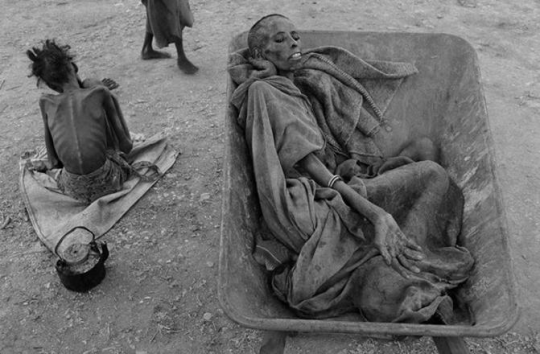
In 1992, James Nachtwey took this photo:
Because he took this photo (among the other equally horrifying and heartbreaking images he brought back from Somalia) and it was published to a large Western audience in the New York Times, The Red Cross received the largest influx of donor aid since WWII, and they were able to save 1.5 million people. Representatives from The Red Cross have directly cited the Nachtwey photos as inspiring that flood of help.
These photos helped save more than a million lives.
It is easy as a bystander – someone who isn’t a journalist, who probably hasn’t been in a war or famine zone – to make sweeping judgments about what journalists should or shouldn’t be doing.
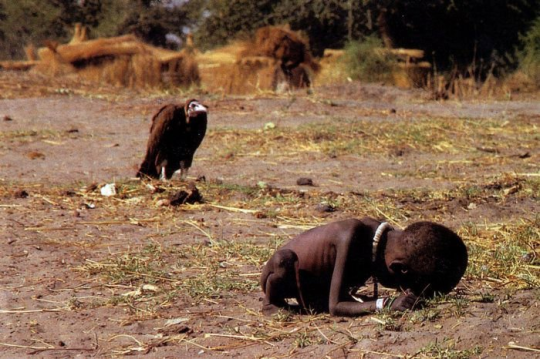
Like this photo from the Sudan by Kevin Carter:
Hundreds of people contacted the paper questioning whether the little girl had survived to which the paper responded through an unusual editor’s note saying that the girl garnered enough strength to walk away from the vulture but her ultimate fate was not known. It was a rule for the journalists in Sudan not to touch victims of the famine, to avoid the risk of transmitting diseases. Carter though came under a lot of criticism for not assisting the girl. The St. Petersburg Times wrote this about him: “The man adjusting his lens to take just the right frame of her suffering might just as well be a predator, another vulture on the scene.”
He chased the vulture away after taking this photo. Note that journalists in the Sudan were not supposed to touch the famine victims to avoid the risk of transmitting disease.
You’ll be pleased to know he committed suicide in 1994, shortly after winning a Pulitzer for this photo, leaving behind a note that talked about the horrors he saw and photographed.
“I am depressed … without phone … money for rent … money for child support … money for debts … money!!! … I am haunted by the vivid memories of killings and corpses and anger and pain … of starving or wounded children, of trigger-happy madmen, often police, of killer executioners…I have gone to join Ken if I am that lucky.”
Now that we just blissfully assume everyone has both a smartphone and access to unrestricted internet, I guess it’s safe to feel critical of the people still putting themselves in the trenches to tell these stories.
These people told stories, and they are continuing to tell stories, that need to be told. We talk about silencing and rewriting history, then criticize the people trying to document it.
When people talk about immigration and refugees, you can show them this picture of the actual human beings sent to their deaths when we turned away the St Louis:
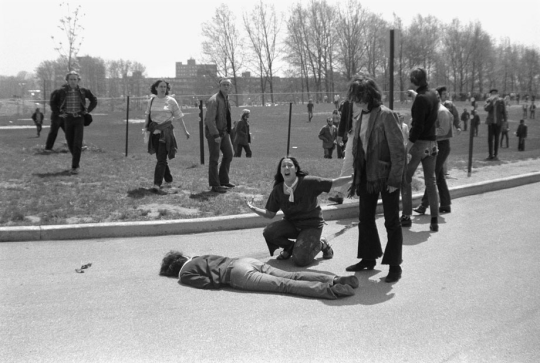
If you want to talk about the violent militarization of law enforcement, you can show someone this photo from the Kent State shootings:
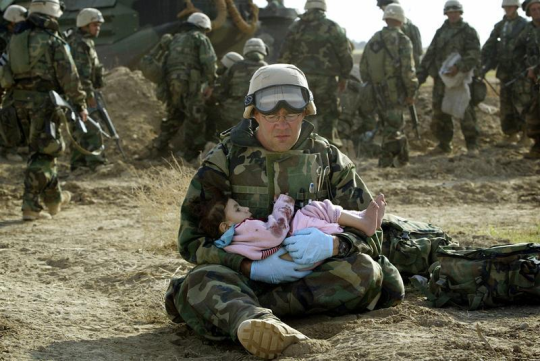
Or maybe the horrific futility of war:
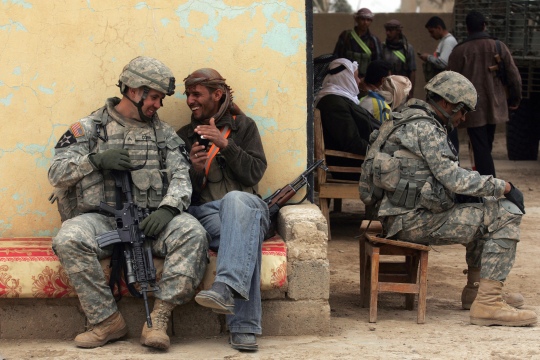
Or maybe the impossible way we connect with each other:
Or you want to showcase dignity:
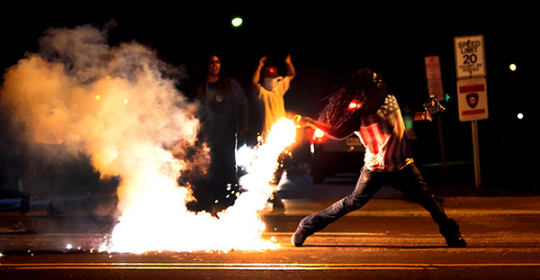
And bravery:
I won’t disagree that “when you lose your humanity, you lose your journalistic integrity,” but I will disagree that intervention is a key component to maintaining journalistic integrity.
Journalistic integrity is telling an authentic story.
The social justice corner of Tumblr often discusses what one person can do to make a difference in the world, yet posts like this get 700,000+ reblogs crapping all over one of those things a single person can do to make a difference.
Net neutrality in the US is on the chopping block and states are debating the ethics of lying in history text books. I’d dare say that the journalists who are out there documenting the world as it exists are doing a job that is as important today as it was in WWII when a single photo from Iwo Jima helped turn the tide of the Pacific campaign.
We’re in a time and place where filming police officers in public is an arrestable offense. So yeah, documenting is an act of intervention and resistance. It’s you saying, “I am not going to let anything stop me from telling the truth.”





 andtheytoldustotellyouhello