“Today on Strange Phenomena, we examine this disturbing habitat. This human has the Bizzare Behavior of doing absolutely nothing productive during much of his life. But on days when a Big Project™ is to be done, he is doing everything but that project. Almost as if avoiding and denying. Even little things that don’t need fixing. It’s a phenomenon he’s survived this long in his life.”
“In 1900, the Russian archaeologist Friedrich Zibold discovered the remains of a mysterious domed structure in the Byzantine Crimean site of Theodosia. After studying the ruins and some terracotta pipes found nearby, he proposed that the structure was an air well designed to condensate moisture from the air into water, and built a replica to test it. This replica was successful and became the precursor of modern air wells. However, it was discovered later that the ancient structure was actually a tomb, the pipes were not related to it, Zibold had used the wrong materials for his replica, and weather conditions at the time (which had included thick fog) had exaggerated the results of the experiment. But by sheer coincidence these materials were the right type to make a working air well—had Zibold used the real ones in the tomb his experiment would have been a failure—and had weather conditions been more characteristic of the area (not as much fog), it wouldn’t have worked as well as Zibold reported it did. Neither of these problems were discovered until 90 years after Zibold’s experiment. In other words, Zibold inadvertently invented a new technology as a result of a failed attempt to replicate a lost technology that didn’t actually exist in the first place.”
I love this kind of thing.
I kind of hope, if we ever meet aliens, that this is our thing. Other species might be better athletes, or record-keepers, or logical thinkers, but we’re the ones who can basically say “Well, I know now that you were kidding about having a ray gun that turns things into sugar, but while you were laughing over how I actually believed it was possible I went and actually made one, and then improved it to the point that I can choose macro-level structures as well so I now have a gun that turns things into skittles.”
I used to work for a call center and I was doing a political survey and I called this number that was randomly generated for me and the way our system worked was voice-activated so when the other person said hello you’d get connected to them, so I just launch right into my “Harvard University and NPR blah blah blah” thing and then there’s this long pause and I think the person’s hung up even though I didn’t hear a click
And then I hear “you shouldn’t be able to call this number.”
So I apologize and go into the preset spiel about because we aren’t selling anything, etc. etc. and the answer I get is
“No, I know that. What I mean is that it should be impossible for you to call this number, and I need to know how you got it.”
I explain that it’s randomly generated and I’m very sorry for bothering him, and go to hang up. And before I can click terminate, I hear:
“Ma’am, this is a matter of national security.”
I accidentally called the director of the FBI.
My job got investigated because a computer randomly spit out a number to the Pentagon.
This is my new favourite story.
When I was in college I got a job working for a company that manages major air-travel data. It was a temp gig working their out of date system while they moved over to a new one, since my knowing MS Dos apparently made me qualified.
There was no MS Dos involved. Instead, there was a proprietary type-based OS and an actually-uses-transistors refrigerator-sized computer with switches I had to trip at certain times during the night as I watched the data flow from six pm to six AM on Fridays and weekends. If things got stuck, I reset the server.
The company handled everything from low-end data (hotel and car reservations) to flight plans and tower information. I was weighed every time I came in to make sure it was me. Areas of the building had retina scanners on doors.
During training. they took us through all the procedures. Including the procedures for the red phone. There was, literally, a red phone on the shelf above my desk. “This is a holdover from the cold war.” They said. “It isn’t going to come up, but here’s the deal. In case of nuclear war or other nation-wide disaster, the phone will ring. Pick up the phone, state your name and station, and await instructions. Do whatever you are told.”
So my third night there, it’s around 2am and there’s a ringing sound.
I look up, slowly. The Red phone is ringing.
So I reach out, I pick up the phone. I give my name and station number. And I hear every station head in the building do the exact same. One after another, voices giving names and numbers. Then silence for the space of two breaths. Silence broken by…
“Uh… Is Shantavia there?”
It turns out that every toll free, 1-900 or priority number has a corresponding local number that it routs to at its actual destination. Some poor teenage girl was trying to dial a friend of hers, mixed up the numbers, and got the atomic attack alert line for a major air-travel corporation’s command center in the mid-west United States.
There’s another pause, and the guys over in the main data room are cracking up. The overnight site head is saying “I think you have the wrong number, ma’am.” and I’m standing there having faced the specter of nuclear annihilation before I was old enough to legally drink.
The red phone never rang again while I was there, so the people doing my training were only slightly wrong in their estimation of how often the doomsday phone would ring.
Every time I try to find this story, I end up having to search google with a variety of terms that I’m sure have gotten me flagged by some watchlist, so I’m reblogging it again where I swear I’ve reblogged it before.
But none of these stories even come close to the best one of them all; a wrong number is how the NORAD Santa Tracker got started.
Seriously, this is legit.
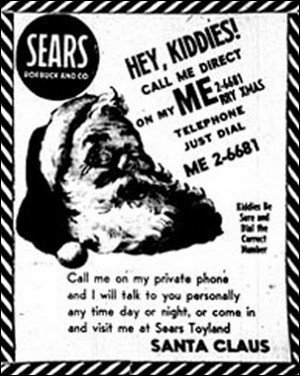
In December 1955, Sears decided to run a Santa hotline. Here’s the ad they posted.
Only problem is, they misprinted the number. And the number they printed? It went straight through to fucking NORAD. This was in the middle of the Cold War, when early warning radar was the only thing keeping nuclear annihilation at bay. NORAD was the front line.
And it wasn’t just any number at NORAD. Oh no no no.
Terri remembers her dad had two phones on his desk, including a red
one. “Only a four-star general at the Pentagon and my dad had the
number,” she says.
“This was the ‘50s, this was the Cold War,
and he would have been the first one to know if there was an attack on
the United States,” Rick says.
The red phone rang one day in
December 1955, and Shoup answered it, Pam says. “And then there was a
small voice that just asked, ‘Is this Santa Claus?’ ”
His
children remember Shoup as straight-laced and disciplined, and he was
annoyed and upset by the call and thought it was a joke — but then,
Terri says, the little voice started crying.
“And Dad realized
that it wasn’t a joke,” her sister says. “So he talked to him,
ho-ho-ho’d and asked if he had been a good boy and, ‘May I talk to your
mother?’ And the mother got on and said, ‘You haven’t seen the paper
yet? There’s a phone number to call Santa. It’s in the Sears ad.’ Dad
looked it up, and there it was, his red phone number. And they had
children calling one after another, so he put a couple of airmen on the
phones to act like Santa Claus.”
“It got to be a big joke at the command center. You
know, ‘The old man’s really flipped his lid this time. We’re answering
Santa calls,’ ” Terri says.
And then, it got better.
“The airmen had this big glass board with the United States on it and
Canada, and when airplanes would come in they would track them,” Pam
says.
“And Christmas Eve of 1955, when Dad walked in, there was
a drawing of a sleigh with eight reindeer coming over the North Pole,”
Rick says.
“Dad said, ‘What is that?’ They say, ‘Colonel, we’re
sorry. We were just making a joke. Do you want us to take that down?’
Dad looked at it for a while, and next thing you know, Dad had called
the radio station and had said, ‘This is the commander at the Combat
Alert Center, and we have an unidentified flying object. Why, it looks
like a sleigh.’ Well, the radio stations would call him like every hour
and say, ‘Where’s Santa now?’ ” Terri says.
For real.
“And later in life he got letters from all over the world, people
saying, ‘Thank you, Colonel,’ for having, you know, this sense of humor.
And in his 90s, he would carry those letters around with him in a
briefcase that had a lock on it like it was top-secret information,” she
says. “You know, he was an important guy, but this is the thing he’s
known for.”
“Yeah,” Rick [his son] says, “it’s probably the thing he was proudest of, too.”
So yeah. I think that might be the best wrong number of all time.








 andtheytoldustotellyouhello