You know, one thing i like about Mulan is how Yao, Ling and Chien Po don’t really seem to care about the fact that Mulan is a girl.
I mean, when they find out, they are visibly perplexed
But even so, they rush and try to help her when she’s about to get killed
After this, they all seem quite depressed about having to leave her behind (and when Shang ignores her)
And when she shows up and takes action, they gladly follow her lead
And they even rock some crossdressing, like she did
(btw they just missed a great opportunity to make Shang crossdress here, shame on you movie)
Honestly, i just think this needs more appreciation. Because to them, Mulan didn’t have to prove herself again, just because she is a girl. She already earned their friendship and respect when she was ‘Ping’, and that was enough.
“Today on Strange Phenomena, we examine this disturbing habitat. This human has the Bizzare Behavior of doing absolutely nothing productive during much of his life. But on days when a Big Project™ is to be done, he is doing everything but that project. Almost as if avoiding and denying. Even little things that don’t need fixing. It’s a phenomenon he’s survived this long in his life.”
I just did a quick perusal of the Coptic resources on this site, and it has all the resources I’ve personally found worthwhile and then some. These are resources that took me months, if not years, to discover and compile. I am thoroughly impressed. The other languages featured on the site are:
Akkadian
Arabic
Aramaic
Church Slavonic
Egyptian (hieroglyphics and Demotic)
Elamite
Ethiopic (Ge’ez)
Etruscan
Gaulish
Georgian
Gothic
Greek
Hebrew
Hittite
Latin
Mayan (various related languages/dialects)
Old Chinese
Old English
Old French
Old Frisian
Old High German
Old Irish
Old Norse
Old Persian
Old Turkic
Sanskrit
Sumerian
Syriac
Ugaritic
For the love of all the gods, if you ever wanted to learn any of these languages, use this site.
Likely helpful for various recon-oriented polytheists.
Sol doesn’t know a lot about his parents. They died when he was a baby, so he only has second-hand accounts and a handful of letters.
Eighteen letters exactly, nine from his father and nine from his mother, all of them written in a period of three months. The last three months they were alive, when they started suspecting their warded-to-high-heavens-and-suppossedly-secret house might not be so secure after all and they should make arrangements for him, in case the worst happened.
He doesn’t know what their favorite colors were, what food they liked or disliked or even who their friends were. But if there is something about them Sol can say with absolute certainity, it’s that they tried.
The relationship of a muggleborn and an ex-Death Eater sounds like the premise of a terrible romance, and to this day Sol struggles to comprehend how he even came into being. Translating that kind of forbidden love to reality leaves him wincing imagining the explosions. Merlin knows Dolly and Kreacher have had enough of those (metaphorical AND literal) that he shudders at the idea of his parents on their place.
But, once upon a time, they had been. They had tried to take care of him as best as they could, and while they didn’t survive long enough to have the most spectacular kind of arguments (that is, the dreaded Sol should be brought up with these values), he supposses that trying to manage a relationship on top of caring for a baby more than made up for the minor blessing of not having to argue over his education.
And all of them had survived it. Their budding relationship, themselves, Sol, Kreacher, Dolly and the house. Though Dolly confessed once with much whispering and averting of eyes that some porcelain figurines and crockery might not have been so lucky.
It’s a daunting thought, because Sol has seen Dolly and Kreacher come close to blows more than enough (and shies away from the thought of how many times he might not have been witness to) to understand that the only reason they (marginally) tolerate each other is him. His parents might have loved each other, but from their letters and their House Elves’ stories, it’s obvious they didn’t figure on each other’s plans for the future (or at least their immediate future with the Blood War raging on their doorstep) until he was born.
It’s not something he was told, but hearing Dolly and Kreacher argue taught him to listen to all sides of an argument and to read between the lines. The line about his father being punched twice on the day he discovered he had had a son was particularly enlightening.
They had still tried, still set aside their differences and done as best they could for him.
In some ways, he is grateful that Kreacher despised his mother enough to tell him about her less-stellar moments and Dolly retorted with the ones from his father (the beginning of their relationship as hate-snogging he could have done without, though), because it makes them seem more real. Actual people and not the idealized images most orphans get. It makes him feel closer to them.
He doesn’t care that they had considered their ideals and plans more important than each other even when his father left the Death Eaters. He doesn’t care that his mother’s Hufflepuff loyalty to her family made her cold (as in premeditated murder cold) to other people, or that his father’s disillusionment with the Death Eaters didn’t make a dent on his contempt for muggles.
They had still loved each other, despite knowing that and probably a lot more. They had still loved him, to the point that they had completely scraped their plans the instant they knew he existed.
His mother had given up on trying to protect his Aunt Lily, who she admitted on one of her letters had been the most important person on her life until that moment.
His father had come out of hiding despite having faked his death and being persona non grata for both sides of the war.
His mother had been willing to raise him as a single woman (worse, a single muggleborn woman) on the Wizarding World and his father had been willing to risk discovery for him.
Even without the hundreds of I love yous on their letters (more on the final letters than the first ones, as they saw the danger coming and became more wary, more desperate and more and more contingency plans failed) he would have known he had been the center of their universe when they had been alive.
Their every action on that war was drenched on their love for him.
Like plotting the Dark Lord’s downfall because, as his mother so bluntly put it on her second-to-last letter, we wouldn’t involve ourselves on this thrice-damned war if we thought we could get away with it, but He will never let it go if He discovers that the Black Heir is a halfblood, so we’ll just have to find a way to permanentely kill that damn cockroach so you can be safe.
Of course, even the first time he read that letter as a child he knew that killing the Dark Lord couldn’t be so simple. And yet, his father had agreed on his letter, more or less confirming that they didn’t care at all for the ideology or the people who died and were dying. They just wanted to be a family and not live in fear, hiding forever.
It was an act motivated purely by their love for him (and, though he suspected they wouldn’t have admitted it at the time, for each other).
Like asking Great-Aunt Cassiopeia to act as intermediary with a Black squib that would be willing to take care of Sol far away from Magical Britain, hiding in plain sight as a magical descendant of the squib line of Blacks in France.
Like ordering Dolly and Kreacher to smuggle him out of the country when the location of their home was finally discovered.
Like casting simultaneous fiendfyres when the wards finally gave and taking as many Death Eaters as they could with them.
Like facing one of the Wizarding World’s most painful deaths (Kreacher spoke with something close to respect for his mother whenever that particular detail came up) just to ensure there wouldn’t be enough left of their home for anybody to suspect that Sol was actually alive.
I don’t know how this happened. I started thinking about the mothers that sent their children overseas during wars and before I realized it…
I’M SO SORRY, SOL! I DIDN’T MEAN TO KILL YOUR PARENTS, I DON’T KNOW HOW THIS HAPPENED.
PS: Please don’t make this canon Tsume-senpai.
It won’t be canon, Kohai, but thank you so much for writing this; I had no idea this was hiding in my messages and you’ve totally eaten into my short ‘reply to messages’ time, but I’m so glad because this was fantastic to read. *side-eyes AFB document* I should probably try and update I guess.
What happens when you leave your precocious 16 year old home alone with the fully-gassed army, his boyfriend, and an overly permissive babysitter named Aristotle.
No, literally. He stole his father’s army while he was away and invaded the neighboring kingdom.
SIMON THANK YOU FOR THIS
I read the words “Fully gassed army, his boyfriend, and an overly permissive babysitter named Aristotle” and snorted coffee all over my desk, because this is the most beautifully true and eloquent way of summarizing Alexander’s formative years I’ve ever seen.
And for others; he did. He absolutely did. This led to some Tension in the family, and when Philip of Macedon was killed there was rampant speculation that Alexander or his mother were behind the killing.
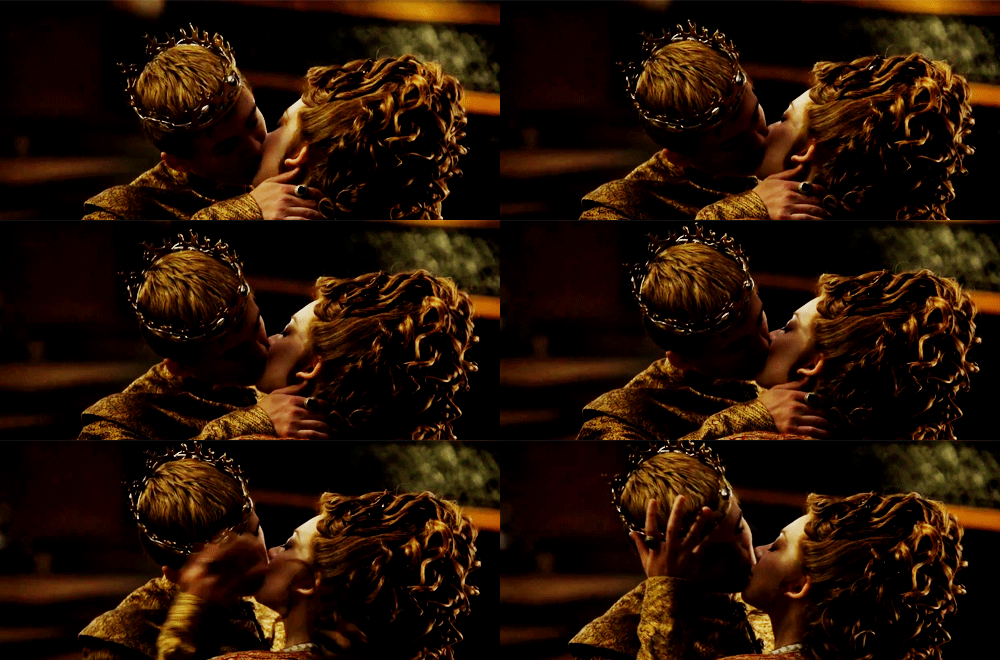
Y/N made a frantic motion to remove herself from Joffrey, but his firm hands kept her in place. Her cheeks flushed a deep red, and she felt her chest constrict. Gods, she knew this would happen, she knew that there had to be some falling out from this, but she’d only wished that they could’ve gotten more time.
Joffrey, on the other hand, was cool, collected, staring unblinkingly at Jamie. “Evening, Uncle.” He breezed coldly, his jaw set firmly. “You’d do well to knock the next time you intrude.” Annoyance leaked through his tone, and he finally relented, releasing the trembling girl still firmly planted on top of him.
“In 1900, the Russian archaeologist Friedrich Zibold discovered the remains of a mysterious domed structure in the Byzantine Crimean site of Theodosia. After studying the ruins and some terracotta pipes found nearby, he proposed that the structure was an air well designed to condensate moisture from the air into water, and built a replica to test it. This replica was successful and became the precursor of modern air wells. However, it was discovered later that the ancient structure was actually a tomb, the pipes were not related to it, Zibold had used the wrong materials for his replica, and weather conditions at the time (which had included thick fog) had exaggerated the results of the experiment. But by sheer coincidence these materials were the right type to make a working air well—had Zibold used the real ones in the tomb his experiment would have been a failure—and had weather conditions been more characteristic of the area (not as much fog), it wouldn’t have worked as well as Zibold reported it did. Neither of these problems were discovered until 90 years after Zibold’s experiment. In other words, Zibold inadvertently invented a new technology as a result of a failed attempt to replicate a lost technology that didn’t actually exist in the first place.”
I love this kind of thing.
I kind of hope, if we ever meet aliens, that this is our thing. Other species might be better athletes, or record-keepers, or logical thinkers, but we’re the ones who can basically say “Well, I know now that you were kidding about having a ray gun that turns things into sugar, but while you were laughing over how I actually believed it was possible I went and actually made one, and then improved it to the point that I can choose macro-level structures as well so I now have a gun that turns things into skittles.”




 andtheytoldustotellyouhello